
Many Relationship Conflicts Don’t Start With Communication Problems. They Start With Interpretation
Kavitha S
3/10/20262 min read
The other day I told my partner, who is also a psychologist, “I’m really excited about learning Emotion Focused Therapy. I’m looking forward to it.”
The instant reply was, “Why would you waste your time on something so silly?”
Boom.
The trigger point was activated, and the argument began almost immediately.
“Of course,” I snapped back, “you never want to support me in anything I do.”
At first glance, this may look like a simple communication problem.
But when I paused and reflected on it later, I realised something else had happened inside me. What I actually felt in that moment was a deep sense of invalidation — as if my thoughts, ambitions, and interests were being dismissed.
And strangely, this feeling was familiar.
It reminded me of something much older. A quiet emotional memory of feeling unseen, unheard, and unvalued as a child.
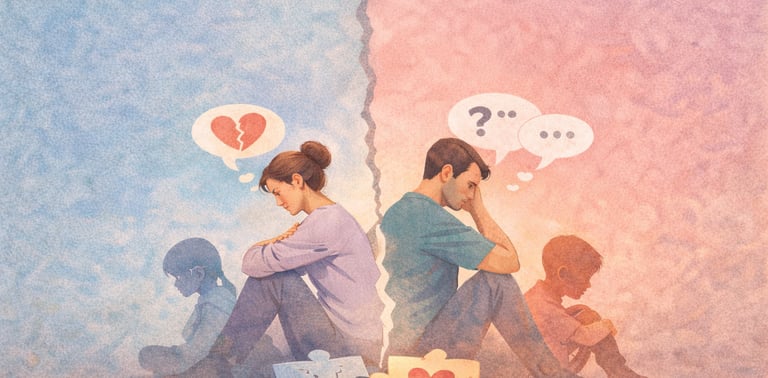
In many relationship conflicts, we don’t simply react to what our partner says. We react to the meaning our mind attaches to it.
More often than not, these meanings are not created in the present moment. They are shaped much earlier, by emotional experiences and wounds we have been carrying with us since childhood.
Research in relationship psychology also suggests that not all couples struggle because they lack communication. In fact, many couples are able to talk openly and have regular conversations.
However, when conflicts do arise, the initial problem often lies in interpretation. One partner may misread the other’s words, actions, or intentions, and that interpretation quickly shapes the emotional response that follows.
For example, a delayed reply might be interpreted as “you don’t care,” while silence may be interpreted as “you’re upset with me.” The emotional reaction then follows the interpretation, not necessarily the intention.
In other words, many arguments begin not because people stop communicating, but because they begin interpreting each other through old emotional lenses.
Another fact that is often overlooked is that more communication is not always the solution. Sometimes, too much talking in the heat of the moment can actually make things worse.
When emotions are already running high, conversations can quickly turn into repeated explanations, defensiveness, or attempts to prove who is right. Instead of creating clarity, the discussion only adds more frustration.
This raises an important question: when is the right time to talk? How much talking actually helps? And when is it wiser to pause and step back before the conversation goes any further?
When in doubt, the safest response is often to pause before reacting and gently ask your partner, “Can I check if I understood you correctly?”
Small pauses can sometimes turn potential arguments into moments of understanding. They give the nervous system a chance to slow down and regulate before emotions take over the conversation.
When we allow ourselves that brief moment to pause, we create space to respond with awareness rather than react from old emotional triggers.
And perhaps most importantly, if you begin to notice that your reactions in conversations consistently lead to arguments or long, exhausting conflicts, it may be an invitation to look inward.
Sometimes these moments are not just about the present conversation, but about the deeper emotional wounds and patterns we carry within us.
More often than we realise, relationship conflicts gently point us back toward our own unfinished emotional work.
A quiet reminder to pause and ask ourselves: What inside me is being triggered right now?
Because sometimes the path to healthier conversations with others begins with a little more understanding of ourselves.
— Kavitha is a psychologist and clinical hypnotherapist exploring emotional patterns, relationships, and inner child healing. Founder of Iyashi Wellness.